22nd March 2026
Emily Micallef
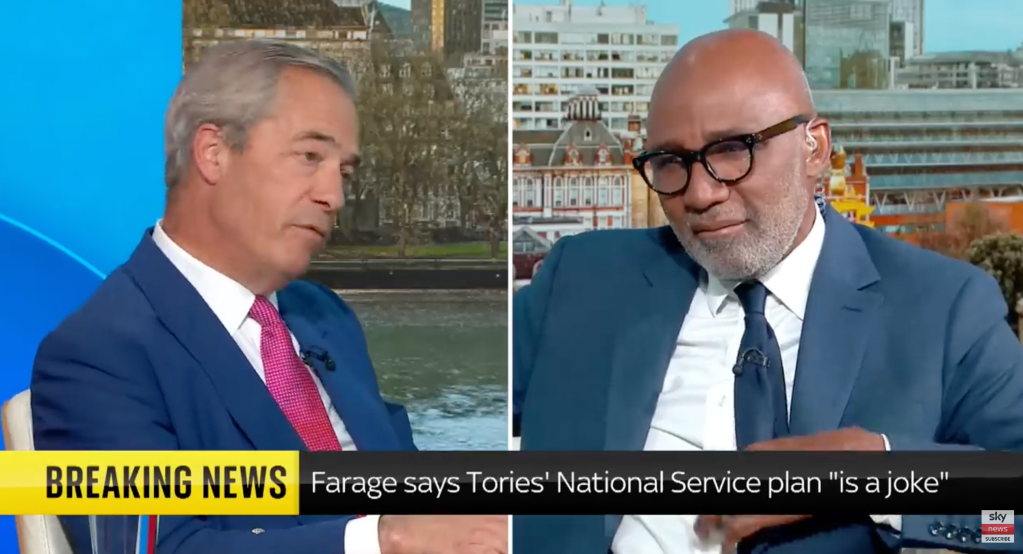
This interview is conducted by Trevor Philips, interviewing the honorary president of Reform UK, Nigel Farage, following claims that Muslims are against British values. In this article, I will analyse their communication skills, focusing on clarity, tone, nonverbal communication, follow-up questions, and control of the interview.
It begins with a strong and direct question related to current news: Does Farage support the government’s proposal for national service? Farage responds by dismissing the policy, describing it as a “joke” and suggesting that even the government does not fully support it. His response is expressive and critical, setting the tone for the rest of the interview. From the beginning, Farage uses repeated hand gestures and open facial expressions, showing confidence but also a defensive and slightly aggressive attitude.
As the interview continues, it becomes more tense when Farage makes claims about elements of the Muslim religion. The interviewer appears visibly uncomfortable and even stutters at one point, which suggests disagreement. He also brings up a personal example, mentioning that his ancestors were Muslim and were forced to convert to Christianity due to slavery. This shows that the interviewer becomes somewhat emotional and personally involved in the discussion.
In terms of non-verbal communication, there is a clear contrast between the two. Trevor Philips often crosses his arms, which can indicate discomfort or disagreement. At certain moments, he also loses eye contact and appears slightly tense and fidgety, frequently changing his posture. In contrast, Farage maintains strong eye contact throughout the interview and uses consistent hand gestures. For example, he points towards the table when emphasizing key points, especially when discussing political reforms. This suggests confidence and control.
The tone of the interview becomes increasingly hostile as the discussion progresses. There are awkward pauses and moments where both participants nod, possibly waiting for reassurance or trying to maintain control of the conversation. Despite this tension, the interview remains focused on the main topic, with both participants returning to the key issues being discussed.
Both participants could improve their communication. Trevor Philips should keep a more neutral tone, as his emotions and body language, such as fidgeting and crossed arms, sometimes make him seem less in control. Speaking more clearly and asking more focused follow-up questions would improve his performance.Nigel Farage could improve by giving more direct answers instead of avoiding the question.His habit of laughing at opposing views can seem disrespectful, so a more balanced tone would help.
Overall, both should stay professional, avoid interruptions, and keep the discussion calm and well-structured.
 Emily's Reporting
Leave a comment