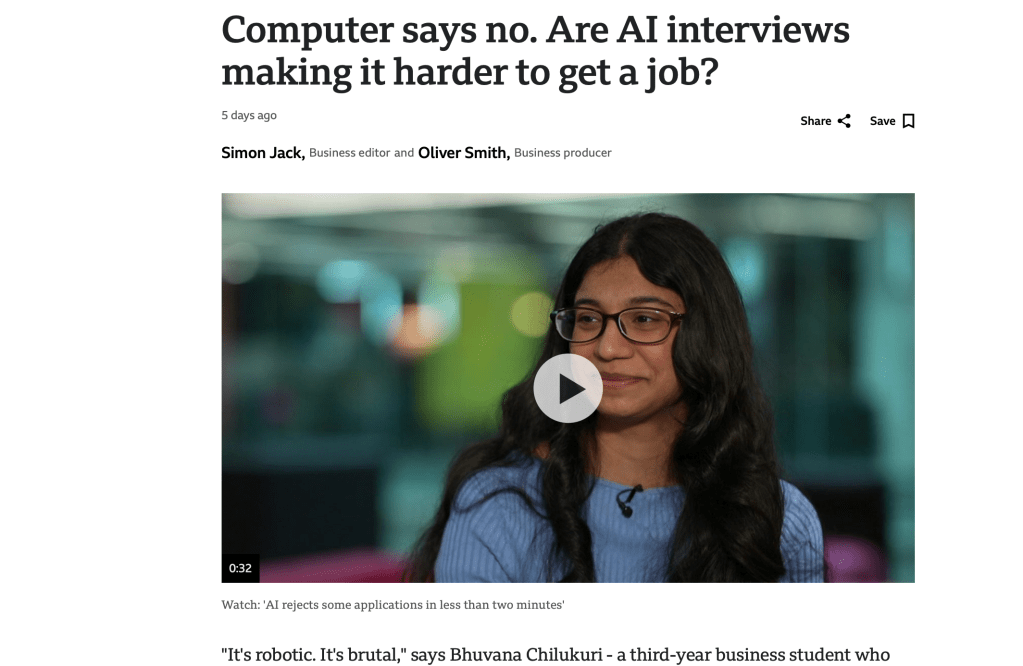
The coverage focuses on how artificial intelligence (AI) is transforming the recruitment process and how this issue is communicated to the audience effectively. I will explain deeply how the structure, tone, and presentation of the story highlights both the advantages and disadvantages of AI in modern hiring.
The Article begins with a personal story about a young business student, Bhuvana Chilukuri, who explains her struggles with finding a job while studying in University. She expected that it would be easier to find employment, but instead she faces repeated rejection. This introduces the main issue of the report, which is how AI is quickly rejecting candidates during the hiring process. The story expands into a wider discussion about the job market and how AI is increasingly being used by companies. It also includes expert opinions explaining why AI is used. The article ends with a balanced view, showing both the benefits and drawbacks of AI. Overall, the structure is clear, logical, and engaging.
The treatment of the article is serious and relevant. It combines emotion and information, showing the frustration of students like Bhuvana while also including statistics. For example, the report mentions that 89% of recruiters use AI, which adds credibility. It also balances both positive and negative aspects. On the negative side, Bhuvana explains how AI makes the process feel “robotic” and removes personality. On the positive side, experts explain that AI helps companies manage large numbers of applications and can make hiring more efficient and consistent.
The presenter plays an important role in guiding the story. It mentions real-life examples, such as Bhuvana’s experience, along with facts, statistics and follow-up questions in the video, to support the message. The tone remains neutral, allowing the audience to form their own opinion. The interviewee, Bhuvana, is very relatable, especially as a young student. She explains how her life is being affected by AI in the job market, particularly in the post-pandemic period. This makes the story more personal and increases its credibility.
The technical elements of the report also support its message. A real-life interview was used in the reel, showing medium shots of Bhuvana, which makes the story feel more human and emotional. There are simple but effective editing techniques, such as fast cuts, calm voice-overs, and embedded subtitles for clearer understanding. The use of b-roll footage, such as typing on a computer, helps illustrate the topic. The opening line, where Bhuvana says she applied for over 100 jobs, is very strong and immediately captures attention.
The article reflects a modern cultural context, focusing on AI in society and the difficulties young people face when trying to find jobs. It also connects to the post-pandemic economy. The main intention of the article is to inform the audience about the use of AI in hiring, show its real-life impact, and raise awareness about its effects on young people.
 Emily's Reporting
Leave a comment