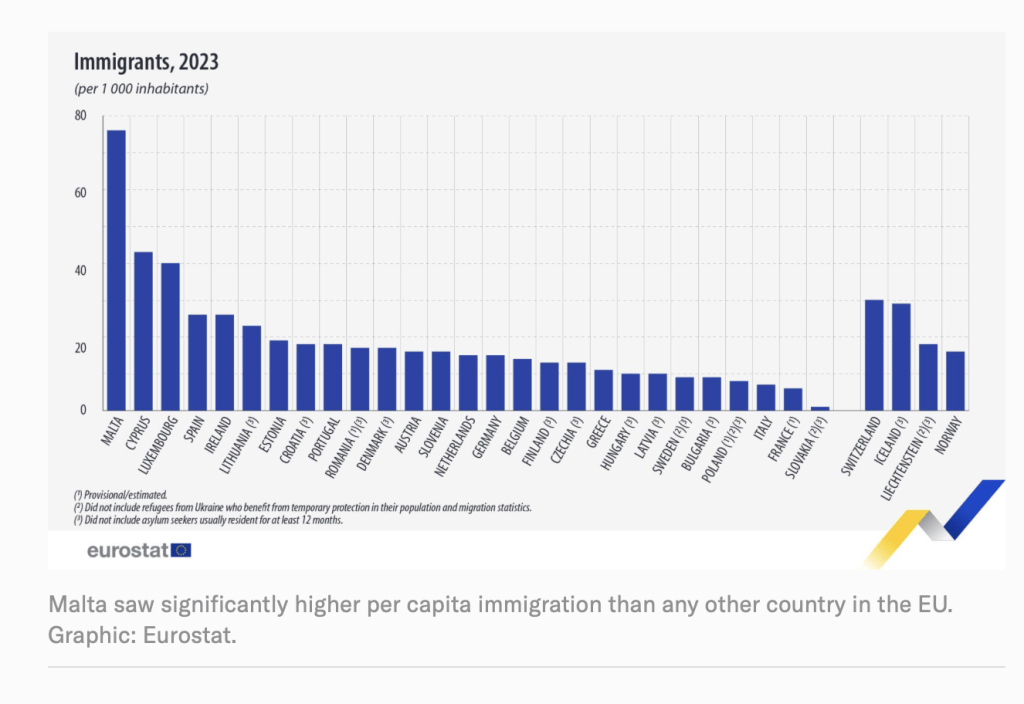
picture from the Times of Malta (31 March , 2025)
According to National Statistics Office Malta, there has been a sharp rise in the foreign population in recent years, increasing from 12.8% to 28%. In 2025, data from Eurostat showed that 76 migrants moved to Malta for every 1,000 people in the population. This was significantly higher than other EU member states, with Cyprus reporting the second-highest figure at 43 per 1,000. As a result, pressure on the country’s social integration systems has reached a critical point. While government-led initiatives, most notably the “I Belong” programme, are designed to support migrants through language and cultural education, questions regarding their practical accessibility and overall effectiveness remain at the forefront of public debate.
Although the “I Belong” programme is officially promoted as a free service to facilitate social cohesion, financial barriers still persist. Reports from advisory platforms, such as Expat Tax Malta, suggest that certain fast-track integration courses held at educational institutions involve significant costs. For individuals already struggling with the high cost of living, financial instability, and limited time due to demanding work schedules, the path to formal integration often feels like an exclusive privilege rather than a public right.
Integration is far more than a legal checkbox; it is about navigating employment, accessing healthcare, and understanding the nuances of a new social fabric. Experts argue that current official systems often focus too heavily on formal compliance—such as passing exams for residency requirements—while neglecting the practical life outcomes of the individuals involved. In this gap, Non-Governmental Organizations (NGOs) have become indispensable.
Organizations like Blue Door Education provide a vital lifeline for adult refugees, asylum seekers, and migrants. Their approach emphasizes that successful integration begins with personal confidence and the mastery of everyday life skills. According to representatives from the NGO, many learners face immense obstacles outside the classroom, ranging from digital illiteracy to severe financial constraints. Their curriculum—covering literacy, language training, and digital skills—reflects a holistic response to real-world needs that formal state programmes sometimes overlook.
Beyond Blue Door Education, other grassroots organizations are also stepping in to address these systemic failures. The Migrant Women Association Malta (MWAM) empowers women through safe community spaces, while youth-led groups like Spark 15 promote inclusion through direct community engagement. The persistent and high demand for these NGO services clearly highlights the functional gaps within the state-led framework.
As Malta transitions into an increasingly multicultural society, the debate over integration policy will only intensify. The future challenge for policymakers lies in balancing structured legal requirements with flexible, person-centered support. Ensuring that integration is not just a bureaucratic hurdle, but a realistic and achievable process for every individual, remains essential for the long-term harmony of the Maltese islands.
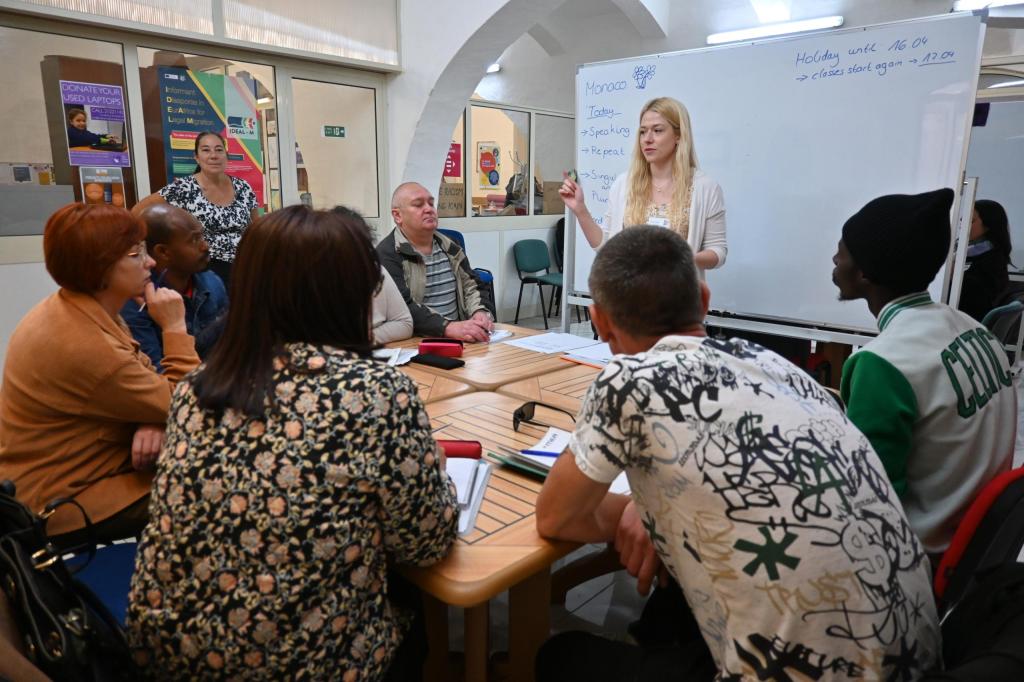
Picture from the Newsbook (2 April , 2023)
- Integration and Anti-Racism Unit Malta (n.d.) I Belong Programme. Available at: https://humanrights.gov.mt/units/integration-and-anti-racism-unit/i-belong-programme/ (Accessed: 26 April 2026).
- Expat Tax Malta (2025) I Belong Stage 1 is under restructuring. Available at: https://expatax.mt/i-belong-stage-1-is-under-restructuring/ (Accessed: 26 April 2026).
- Migrant Women Association Malta (n.d.) What we do. Available at: https://migrantwomenmalta.org/what-we-do/ (Accessed: 26 April 2026).
- Spark 15 (n.d.) Who we are. Available at: https://spark15.org/who-we-are/ (Accessed: 26 April 2026).
- Blue Door Education (n.d.) What we do. Available at: https://www.bluedooredu.org/what-we-do (Accessed: 26 April 2026).
- National Statistics Office (2024) Population and Migration Statistics. Available at:https://nso.gov.mt/contrasting-population-dynamics/ (Accessed: 30 April 2026).
- Times of Malta (2025) Malta’s immigration rate was 75% higher than any other EU state’s in 2023. Available at https://timesofmalta.com/article/malta-immigration-rate-75-higher-eu-state-2023.1107434 (Accessed: 30 April 2026).
2. Production Planning & Rationale
Locations:
- Valletta Public Streets: Used for the stand-upper and B-roll to capture the everyday environment of a multicultural society.
- Blue Door Education Office: Used for the primary interview to provide an authentic organizational perspective.
- MCAST Campus: Used for capturing visual evidence of the educational aspect of integration.
Location Rationale (MCAST Selection): While our initial research aimed to film at official government administrative offices, we encountered significant accessibility barriers, as multiple agencies declined student interview requests citing privacy protocols.
Consequently, MCAST was strategically selected as a primary filming location because it is the official delivery partnerfor the government’s “I Belong” Programme (Stage 1). According to the Human Rights Directorate (HRD), MCAST is the actual site where mandatory Maltese and English language courses are conducted for migrants to obtain MQF Level 1 certification. By filming here, especially during the MCAST Diversity Day (29th April), we are capturing the actual implementation phase of Malta’s integration policy in a real-life educational setting. This ensures the reliability and authenticity of our visual material while navigating the practical challenges of institutional access.
Interview Focus:
- Subject: Representative from Blue Door Education.
- Key Themes: Practical barriers to integration, the role of NGOs in supporting vulnerable communities, and the limitations of current formal systems.
Mise-en-scene & Technical Standards:
- Visual Style: Using the Rule of Thirds for interviews and capturing candid B-roll to reflect realism.
- Audio Standards: All audio will be mixed to industry-standard -23 LUFS to ensure broadcast quality.
- Equipment: High-definition camera, stabilizer, and Rode external microphones.
questions.
Section 1: Organisational Role & Vision
1. How does Blue Door Education define “successful integration” within the Maltese context?
2. In your experience, what are the most critical barriers that adult learners face when trying to integrate through education?
Section 2: Educational Impact & Support
3. Beyond language acquisition, what secondary skills (e.g., cultural navigation, employability) do you find are most vital for your students?
4. How has the demand for your services changed in the past 2-3 years, and what do you think is driving these trends?(extra)
Section 3: Community & Policy
5. How does Blue Door Education collaborate with other local NGOs or government bodies to ensure a holistic support system?(extra0
6. What policy changes in Malta would most significantly improve the integration outcomes for the community you serve?
 Emily's Reporting
Leave a comment